Family patterns rarely arrive as grand declarations. They show up in who apologizes first, who goes quiet during conflict, who becomes the household translator, who carries the calendar in their head, and who learned long ago that being “easy” felt safer than having needs.
For the person protecting a family system, this can feel exhausting. You may sense that the same friction keeps repeating across generations, yet naming it without blaming anyone is hard. Numaura’s approach to Family Architecture gives you a structured way to observe those patterns with compassion. It treats each person’s numerology profile as an input signal, not a fixed verdict. The goal is not to label relatives. The goal is to understand how behavioral baselines interact, where inherited roles get reinforced, and where a new response can interrupt an old loop.
Universal Input Logic supports that process by translating birth date and name data into repeatable numerological inputs. When applied carefully, it can help families see why one child resists pressure, why one parent over-functions, why siblings remember the same home differently, and why certain relatives seem assigned to roles they never consciously chose.
Core Takeaways
- Family Architecture views the household as an interactive system shaped by individual baseline patterns, learned roles, and generational timing.
- Universal Input Logic offers a consistent way to compare numerology inputs without turning family members into stereotypes.
- Inherited Roles often form when a child’s natural response style gets rewarded, overused, or misunderstood.
- The most protective use of numerology is practical: better language, cleaner boundaries, and more accurate expectations.
What Is Family Architecture in a Family System?
Family Architecture is the study of how repeated household roles, baseline responses, and generational timing shape the way family members relate to one another. Every family has informal assignments. One person becomes the stabilizer. Another becomes the truth-teller. Someone is treated as fragile, even when they are capable. Someone else is praised for independence until they stop asking for care altogether. These assignments are not always spoken, but they often become predictable through repeated reactions. A sensitive child cries easily, so adults manage around their feelings. A quick-thinking child learns to mediate adult tension, so they become useful in conflict. A responsible child handles more than their age should require, and the family praises them for maturity instead of noticing the cost. Family Architecture names these assignments as patterns, not personal flaws, so the system can be understood with more Clarity.
It asks a grounded question: what happens when each person’s natural baseline meets the family’s unmet needs? That intersection is where many Inherited Roles begin.
For an Empowered Protector, this matters deeply. You may already be the person people call when a parent is upset, a sibling shuts down, or a child is acting out. You may have developed a gift for translating intent, impact, and emotional subtext. Still, translation can become unpaid labor if you are always the bridge and never the person being understood.
A numerology lens can help you step back far enough to see the structure. Not to detach from love, but to stop absorbing every reaction as your responsibility.
This guide maps the whole system, including how baselines interact across a household. If you want to work through one specific person's inherited obstacle pattern first, Numaura's guide to Challenge Numbers and family friction is the narrower, single-person starting point.
What Is Universal Input Logic in Family Pattern Work?
Universal Input Logic is the consistent method Numaura uses to convert birth date and name information into numerology inputs that can be compared across a family system. In this context, the value is not a fixed claim about destiny. The value is repeatability. If the same date and name data produce the same core inputs every time, families can discuss tendencies with less defensiveness and more Alignment. A parent is no longer simply “too controlling.” They may be working from a baseline that seeks structure when uncertain. A child is not simply “difficult.” They may test limits before trusting them. This shared language helps separate pattern from intention, and intention from impact. It gives protectors a neutral reference point when old family stories have hardened into labels that no longer serve the people living inside them.
That difference in language matters. Families often suffer because the story hardens before the person is understood. “She is selfish.” “He never listens.” “They always make everything emotional.” These summaries become family law, and once they do, each person has to fight the role before they can be seen clearly.
Universal Input Logic does not erase accountability. It adds context. If you want a deeper technical explanation of how Numaura converts birth date and name into inputs, you can read the guide to Universal Input Logic for birth date and name.
The protective parent needs more than instinct
Protective people often have excellent instincts. You notice tone shifts. You can tell when a child is overstimulated, when a partner is withdrawing, or when an aging parent is masking fear with criticism. You read the room fast because you had to learn.
Instinct, however, can become strain when it has no framework. If every conflict relies on your emotional scanning, you become the family’s nervous system. You anticipate, soften, explain, repair, and absorb. Over time, even love starts to feel like monitoring.
Family Architecture gives your instinct a set of shelves. It helps you sort what belongs to temperament, what belongs to learned behavior, what belongs to stress timing, and what belongs to a generational role. The result is not distance. It is cleaner care.
For example, a child with a strong independence pattern may resist instructions that feel too tight. A parent with a strong responsibility pattern may respond by increasing control. The child then pushes harder, the parent tightens further, and both feel unseen. Without a shared language, the family calls this defiance or disrespect. With a pattern-aware view, the family can test a new approach: more choice within firm limits, fewer lectures, clearer agreements.
Small adjustments can change the whole room.
What Are Inherited Roles in a Family System?
Inherited Roles are repeated family assignments that usually begin as adaptations and then continue long after the original pressure has passed. The peacemaker reduces tension. The achiever restores family pride. The rebel expresses anger no one else will admit. The caretaker keeps everyone functioning. The invisible one avoids adding burden. These roles are not always harmful at first. Many began because someone was trying to keep the household stable, safe, or emotionally manageable. The strain begins when the family forgets the role was a response, not the whole person. A child who once helped the system survive may later feel trapped by the behavior that earned approval. When numerology is used carefully, it can point toward the pressure beneath the role and show where a natural response style may have been rewarded, overused, or misunderstood across family Cycles.
This is common in parent-child patterns. A child who becomes the “easy one” may grow into an adult who struggles to state preferences. A child labeled “dramatic” may stop trusting their own emotional signals. A child seen as “the strong one” may receive less tenderness because others assume they can handle anything.
Ready to Begin Your Journey?
Your numerology has been waiting for you all along. The first step is simple...
Numerology can help identify the pressure point beneath the role. That does not mean you are stuck there. It means your family role may have formed around that pressure, especially if the household rewarded one side of your nature and ignored the rest.
This is where compassion becomes practical. When you see a role as an adaptation, you can stop shaming the person for using it. Then you can ask whether it still serves the family now.
Mapping the vertical line: grandparents, parents, children
Intergenerational patterns are easiest to see when you look vertically. Not just across siblings, but through time.
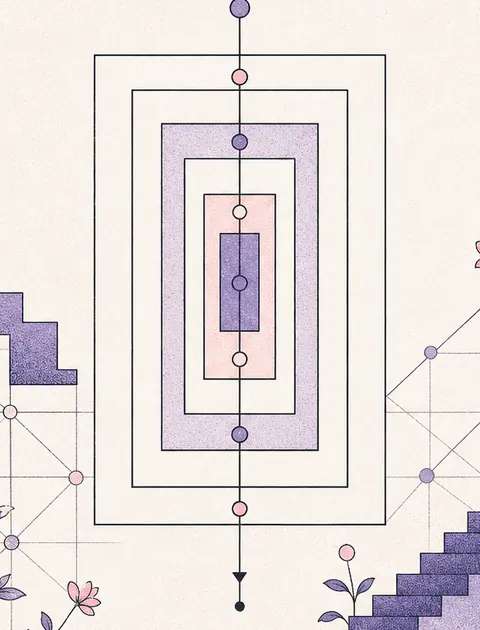
Start with a simple chronological axis: grandparents, parents, children. Place each person on the line by birth order and family position. Then note the repeated assignments. Who carried responsibility too early? Who left emotionally or physically? Who managed money, conflict, illness, silence, or reputation? Who was allowed to be angry? Who was allowed to rest?
This exercise is not about proving blame. It is about locating pattern transfer. A grandmother who had no support may raise a daughter to be self-sufficient at all costs. That daughter may then struggle to comfort her own child’s dependence. The child, sensing that need creates tension, may learn to hide vulnerability. Three generations later, everyone is “fine,” and nobody knows how to ask for help.
Family Architecture makes the invisible sequence visible. A numerology profile can add another layer by showing whether certain family members share similar baseline numbers, repeat challenge themes, or carry contrasting response styles that easily misread one another.
If you are studying your own family line, pay attention to repetition without rushing to interpretation. Repetition is data. It becomes useful when paired with honest observation.
The horizontal line: sibling roles and household balance
Siblings often live in the same house but grow up inside different emotional climates. One child may meet a parent during ambition years, another during grief, another during financial pressure, another after the parent has done personal repair. Birth order matters, but timing matters too.
Universal Input Logic can help compare sibling baselines without ranking them. A child with a strong expressive pattern may need language and movement. A child with a strong analytical pattern may need privacy before speaking. A child with a strong service pattern may over-help and then resent being needed. When these children share a household, the family system starts assigning jobs almost automatically.
One child becomes “the loud one,” another “the responsible one,” another “the sensitive one.” These names may sound harmless, but they can become containers. Children often behave toward the role adults expect, especially when it earns attention or safety.
For parents, the task is translation. Instead of saying, “Why can’t you be more like your brother?” a pattern-aware parent might say, “You both handle pressure differently. He needs space before responding. You need to talk while the feeling is fresh. Let’s make room for both without letting either person dominate.”
That kind of sentence can lower rivalry. It teaches children that difference is not danger.
Life Path patterns as family communication signals
The Life Path number is one of the most referenced numerology inputs because it is drawn from the birth date and speaks to core developmental themes. In family work, it can be used as a communication signal that shows how a person tends to approach growth, pressure, purpose, and choice. This does not mean the Life Path should become a label or a shortcut for judging relatives. Its practical use is to help the family listen for needs beneath behavior. A person may push back because they need autonomy, seek reassurance because connection feels uncertain, or over-help because service has become the safest way to belong. When Life Path patterns are read as signals, the protector can translate conflict without making anyone smaller. The number becomes one layer of Clarity, sitting beside lived history, consent, timing, and the person’s own words.
If you need a refresher on the basic Life Path framework, Numaura’s guide to Life Path number meaning gives a helpful foundation. For family pattern analysis, the purpose is not to memorize labels. The purpose is to listen for needs beneath behavior.
A person with an independence-oriented pattern may need room to initiate. A relationship-oriented pattern may need reassurance that connection is stable. A creative pattern may need expression before structure. A builder pattern may need plans, timelines, and proof of reliability. A freedom-oriented pattern may resist routines that feel like confinement. A caretaker pattern may need permission not to rescue. A reflective pattern may need quiet processing time. A power-oriented pattern may need responsibility without domination. A humanitarian pattern may need to learn that caring for everyone cannot replace personal boundaries.
Master Numbers require extra care. If 11, 22, or 33 appears in a numerology profile, Numaura does not reduce it to a single digit. These numbers carry an elevated vibration, which often shows up as intensified sensitivity, responsibility, or service pressure. In family systems, that intensity can be misunderstood. A Master Number child may seem “older than their age,” but that does not mean they should be treated as an adult. A Master Number parent may feel called to support everyone, but that calling still needs limits.
The family benefit comes from respecting intensity without exploiting it.
See Your Full Blueprint
This is one piece of your pattern. A full Numerology Blueprint report maps your Life Path, Expression, and Soul Urge together for $20.
When protection becomes over-functioning
Many family protectors learned that love means staying alert. You might track everyone’s moods, prevent arguments before they start, remind adults to take care of themselves, or explain one person’s pain to another in softer words.
These skills can be beautiful. They can also become over-functioning.
Over-functioning happens when one person consistently does the emotional, logistical, or relational work that belongs to several people. Inherited Roles often hide inside this pattern. The protector may believe, “If I do not manage this, everything falls apart.” Sometimes that belief came from real experience. Sometimes it was handed down by a parent who also carried too much.
Family Architecture asks a careful question: what would happen if responsibility were redistributed according to capacity, not habit? A teenager can own their apology. A partner can learn the child’s schedule. A parent can speak directly to a sibling instead of using you as the messenger. An adult child can care about an aging parent without becoming the only point of contact.
This is where numerology must stay practical. If your Life Path pattern tends toward service, leadership, harmony, or responsibility, you may be especially vulnerable to becoming the household support beam. Your growth is not to stop caring. It is to care without disappearing.
A practical method for mapping your family system
A clear map begins with observation, not accusation. Set aside one quiet hour. Use paper if possible, because seeing the family structure outside your head often softens the emotional charge.
Step 1: Place each person in the structure
Write the names of immediate family members, then add grandparents or influential relatives if they shaped the household. Include people who were absent, because absence still affects structure. A missing parent, estranged sibling, or silent grandparent may carry more influence than the family admits.
Step 2: Note repeated roles
Beside each person, write the role they are most often assigned. Use simple language: fixer, achiever, critic, peacekeeper, outsider, caretaker, truth-teller, dependent one, invisible one. Avoid permanent labels. You are naming a pattern, not sentencing a person.
Step 3: Add numerology inputs
Add each person’s core Life Path number if you have it. If you are working with relatives, keep their information private and respectful. Numerology should never become a weapon in family arguments.
Step 4: Look for friction points
Circle pairs that often misunderstand each other. Ask what each person may be protecting. Control may protect fear. Withdrawal may protect overwhelm. Criticism may protect helplessness. People often fight from the place they least want seen.
Step 5: Choose one role to loosen
Do not try to repair the entire family at once. Pick one role and test a new response for two weeks. If you are the translator, let two capable adults speak directly. If you are the rescuer, offer support without taking over. If you are the silent one, state one preference clearly and calmly.
Progress often begins with one redistributed responsibility.
Reading conflict as mismatched operating needs
Family conflict is often described as personality clash, but many clashes are mismatched operating needs. One person needs certainty before acting. Another needs movement before clarity. One person processes through conversation. Another processes through solitude. One person treats questions as connection. Another hears them as interrogation.
This is where the relationship translator has real power. You can reframe conflict in language that lowers threat.
Instead of “Dad is controlling,” try, “Dad seems to calm down when there is a plan, but the plan is landing as pressure.” Instead of “My child is disrespectful,” try, “My child may be fighting for choice, and I still need to hold the boundary.” Instead of “My sister never helps,” try, “She may not see invisible labor unless tasks are named clearly.”
These reframes do not excuse harm. They create a cleaner entry point for repair. When families understand the need under the behavior, they can negotiate with less shame.
Universal Input Logic supports this by giving families a neutral reference point. A profile can say, “This person tends to require autonomy under stress,” or “This person may seek harmony before honesty.” The statement becomes a mirror, not a weapon.
Bring the Whole Family In
Patterns get clearer in context. A Family Blueprint covers up to 4 members for $40, so everyone's Cycles line up on one map.
The ethics of using numerology inside family systems
Numerology becomes harmful when it is used to trap people inside assumptions. A child should never hear, “You are a 5, so you cannot commit,” or “You are an 8, so you are bossy.” A partner should not be dismissed because their number appears difficult. A parent should not use a profile to justify control.
The ethical use is softer and more disciplined. Treat every numerology input as a hypothesis to test through lived experience. Ask, “Does this help us understand each other more accurately?” If the answer is yes, use it. If it creates fear, superiority, or fatalism, pause.
Children deserve special care. Their patterns are still developing. A numerology profile can help a parent support a child’s needs, but it should never replace listening. The child in front of you is more important than any interpretation about them.
Family Architecture works best when paired with consent, privacy, and humility. You are not diagnosing your relatives. You are studying interaction patterns so the family can become more humane.
Creating alignment without forcing sameness
Alignment in a family does not mean everyone agrees. It means the structure can hold difference without making one person carry the emotional cost for all.
A household aligned around respect will still have conflict. People will still misread each other, forget agreements, speak too sharply, or need repair. The difference is that conflict does not automatically push everyone back into inherited roles. The fixer does not have to fix every rupture. The quiet one does not have to vanish. The intense one does not have to be shamed for feeling strongly. The responsible one does not have to manage every detail alone.
This is the deeper promise of Family Architecture. Once you can see the structure, you can adjust it. Not perfectly. Not all at once. But enough to change the next conversation, the next holiday, the next parenting decision, the next moment when an old role asks you to step back into it.
For protectors, that can feel unfamiliar. Peace may no longer depend on your constant effort. Love may become more mutual. Care may become shared.
Bringing your own profile into the family map
Your own numerology profile is the best place to begin because it is the one you can use with full consent. When you understand your Life Path, challenge themes, and communication tendencies, you can see where you may over-identify with a family role.
A leadership pattern may have been pushed into control. A harmony pattern may have been pushed into people-pleasing. A freedom pattern may have been labeled unreliable. A service pattern may have been praised until rest felt selfish.
The question is not “Who did this to me?” The more useful question is “Which role am I still performing, even when the original pressure is gone?”
That question can change how you parent, partner, and relate to siblings. It can help you stop handing your children the roles you are trying to heal. It can help you speak to your parents with clearer boundaries and less accusation. It can help you protect your family without becoming the only person responsible for its emotional health.
If you are ready to place your own core input into the family map, start with Numaura’s free calculation tool at the numerology calculator. From there, a complete family numerology report can map every person in the system side by side. Use the result as a reflection point, then compare it with the roles, expectations, and cycles you have lived inside.
The pattern can continue, or it can be revised
Intergenerational work does not require rejecting your family. Often, it requires seeing them more accurately than the old story allowed. Your parents may have been shaped by pressure they never named. Your grandparents may have survived by becoming rigid, silent, self-sacrificing, or severe. Your children may be reacting not only to you, but to unspoken patterns moving through the household.
Seeing this does not remove responsibility. It places responsibility where it belongs. Each adult can own their behavior. Each child can be supported according to their needs. Each family role can be questioned before it becomes another inheritance.
Family Architecture offers a practical form of compassion. Universal Input Logic gives the process consistency. Together, they help the protector become more than the translator of everyone else’s pain. They help you become a conscious designer of healthier patterns, one interaction at a time.
The family system may have trained you to carry the structure. You are allowed to study it instead. You are allowed to change how it is held.