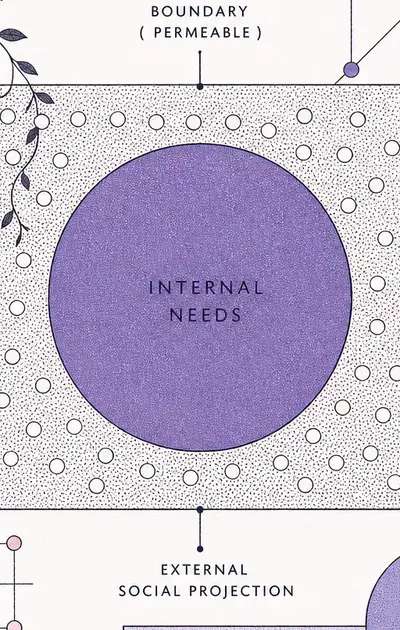
Social capacity is not a moral score, a personality flaw, or a sign that you are failing at connection. It is the amount of social input your system can meet before your presence starts to feel borrowed rather than chosen. When that limit stays unnamed, you may overexplain, disappear, snap, people-please, or call yourself “too much” or “not enough.” Your Personality Number gives language to the version of you others tend to meet first, which makes it a grounded tool for setting boundaries without turning every limit into an emotional negotiation.
Key Takeaways
- Your Personality Number reflects the social style others often perceive first, which can clarify why certain interactions drain or strengthen you.
- Boundary setting works best when it protects your capacity before resentment appears, not after exhaustion has already taken over.
- Social limits become easier to communicate when they are tied to observable needs, timing, and energy patterns.
- Your number is not an excuse to withdraw or overperform. It is a mirror that helps you choose cleaner agreements.
- Personalized numerology can help pattern breakers stop repeating inherited social scripts and start relating from Alignment.
What Is a Personality Number in Numerology?
A Personality Number is the numerology number associated with the outer layer of your identity, especially the traits other people tend to notice before they know your full story. In most Pythagorean numerology systems, it is calculated from the consonants in your full birth name, while vowels are used for the Soul Urge Number and the full name supports the Expression Number. Your Personality Number does not describe everything you are. It points to your social interface, the tone, style, pace, and protective shape others may experience from you. That matters for boundaries because many people set limits based on private feelings while ignoring the signals their presence sends. If your outer style reads open, capable, intense, reserved, charming, or caretaking, people may respond to that impression before they respond to your stated needs. Learning this number helps you notice where your social mask works, where it protects you, and where it quietly costs you.
For a deeper foundation on the calculation itself, Numaura’s guide to Personality Number meaning can help you understand how this number fits inside your wider numerology profile. Here, the focus is more specific: how this number can support clear limits, safer relationships, and less guilt around needing space.
That sentence is not meant to box you in. It gives you a place to start noticing what your body already knows.
Why Boundary Setting Feels So Personal
Boundary setting feels personal because many of us learned social survival before we learned self-trust. A child who had to keep adults calm may become an adult who feels responsible for everyone’s comfort. A teenager praised for being easygoing may struggle to say no without performing warmth first. A sensitive person who was called dramatic may understate every need until resentment leaks out sideways.
Pattern breakers often carry a strange burden. You are not only deciding what you need now, you are also interrupting a family rule, a friendship pattern, or a relational bargain that once kept you safe. That can make even a simple sentence feel charged. “I can’t make it tonight” may not feel like a calendar update. It may feel like betrayal.
Your Personality Number helps separate the present from the old script. It gives you a neutral lens. Instead of saying, “I’m bad at boundaries,” you can ask, “What social role do people expect from me, and where have I mistaken that role for my responsibility?”
That shift is gentle, but it is not soft. It changes behavior.
How Does Your Personality Number Shape Social Capacity?
Your Personality Number shapes social capacity by showing the style of interaction you may naturally project, which affects how much access others assume they have to your time, attention, and emotional energy. Someone with a warm, expressive outer style may attract frequent requests for connection, even when they privately need long recovery periods. Someone with a composed or independent outer style may be left alone when they actually need reassurance. A person who appears competent may become the default fixer, while a person who appears curious may become the listener who absorbs everyone else’s processing. The number does not determine your stamina by itself. Rather, it highlights the gap between how you are perceived and what your nervous system can sustain. Boundary setting becomes more accurate when you account for that gap. You stop judging your capacity against your image and begin protecting the actual energy you have.
This is where the extrovert and introvert labels often fail. Someone can look socially bright and still need firm recovery time. Someone can seem quiet and still crave consistent contact with trusted people. If you have been misread for years, you may have built boundaries around a false identity.
Numaura explores this tension in the extrovert myth and social capacity, especially for people who get mistaken for “always available” because they know how to appear present. That misreading can become expensive. You may keep showing up because people like the version of you who performs ease.
Your body pays the bill later.
The Social Mask Is Not the Enemy
The outer self gets unfairly blamed. People hear “mask” and assume something fake is happening. Often, the social mask began as intelligence. It helped you read rooms, avoid conflict, win approval, protect tenderness, or stay functional when your inner world was not safe to share.
A Personality Number can reveal the shape of that mask without shaming it. Maybe your outer presence says, “I can handle it.” Maybe it says, “I’m fine alone.” Maybe it says, “Tell me everything.” Maybe it says, “I’ll make this lighter for everyone.” None of those messages are wrong. Trouble begins when people believe the message is the whole truth, and you feel trapped maintaining it.
Healthy boundaries do not require you to destroy your social style. They ask you to update it. You can still be generous without being constantly reachable. You can still be warm without saying yes. You can still be private without turning silence into a wall.
Alignment begins when the outer self stops working against the inner self.

What Are the Boundary Patterns of Each Personality Number?
The boundary patterns of each Personality Number show how a person’s perceived social style may attract certain expectations, pressures, and misunderstandings. These patterns are general references, not personalized predictions, and they should not replace your full chart or lived experience. Numbers 1 through 9 each carry a distinct social signal: some appear strong, some nurturing, some magnetic, some serious, some adaptable. That signal can become a source of ease when it matches your true capacity, or a source of strain when others lean on it without consent. The purpose of studying these patterns is not to label yourself. It is to notice recurring friction with more compassion. If a description feels uncomfortably accurate, treat it as information rather than a verdict. You are allowed to revise how much access people get to the qualities they expect from you.
Personality Number 1: The Self-Directed Presence
Personality Number 1 often reads as capable, decisive, and self-contained. People may assume you need less support than you do. Your boundary growth is letting others see limits before you become irritated that they failed to notice them.
A clean boundary for 1 energy might sound like: “I can lead this part, but I’m not available to carry the whole thing.” That sentence protects agency without turning every request into a power struggle.
Personality Number 2: The Sensitive Connector
Personality Number 2 tends to be perceived as receptive, caring, and emotionally aware. People may bring you their feelings without asking if you have room. Your boundary work is learning that empathy does not require unlimited availability.
Ready to Begin Your Journey?
Your numerology has been waiting for you all along. The first step is simple...
Try language that keeps warmth intact: “I care about this, and I don’t have the capacity to process it tonight.” For 2 energy, the guilt may rise fast. Let it rise. You do not have to obey it.
Personality Number 3: The Expressive Brightener
Personality Number 3 can appear lively, creative, funny, or socially open. Others may expect entertainment, quick replies, or emotional lift from you. The hard part is admitting when brightness has become labor.
A useful boundary is: “I’m quieter today, so I’m going to keep this low-pressure.” This lets your social circle meet the real you, not just the sparkling version they prefer.
Personality Number 4: The Steady Builder
Personality Number 4 often gives the impression of reliability and structure. People may assign you responsibility because you seem grounded enough to manage it. Your growth is refusing the role of default stabilizer.
You might say: “I can support a clear plan, but I’m not available for last-minute chaos.” That kind of limit protects time, energy, and the peace you need to function well.
Personality Number 5: The Adaptive Free Spirit
Personality Number 5 may read as flexible, adventurous, and easy to involve. People might assume you are always open to changes, spontaneous plans, or intense stimulation. Your boundary lesson is protecting freedom from becoming over-accessibility.
A strong phrase for 5 energy is: “I’m keeping that day open for myself.” No long explanation needed. Freedom includes the right to choose stillness.
Personality Number 6: The Nurturing Anchor
Personality Number 6 is often seen as responsible, loving, protective, or family-oriented. People may expect care from you before they ask what it costs. This can be especially painful for pattern breakers who were trained to earn love through usefulness.
A healing boundary might be: “I can help with one part, but I can’t take responsibility for the whole situation.” This keeps care from turning into self-abandonment.
Personality Number 7: The Private Observer
Personality Number 7 tends to appear thoughtful, contained, perceptive, or hard to read. People may either overpursue you or assume your silence means disinterest. Your boundary work is naming your need for space without disappearing into it.
Try: “I need time alone to reset, and I’ll check in tomorrow.” That sentence protects solitude while reducing confusion for people who matter.
Personality Number 8: The Powerful Organizer
Personality Number 8 often reads as strong, ambitious, composed, or in control. Others may bring problems to you because they trust your force. They may not notice when you are tired because your outer layer still looks steady.
A direct boundary can be: “I’m not available to solve this, but I can suggest one next step.” This protects your energy while keeping your integrity intact.
Personality Number 9: The Compassionate Holder
Personality Number 9 can appear wise, accepting, and emotionally spacious. People may confess, collapse, or seek forgiveness from you because your presence feels broad. Your challenge is remembering that compassion without limits becomes exhaustion.
A fitting boundary is: “I care about your healing, but I can’t be the place where all of this lands.” That is not cold. It is honest care with a door and a threshold.
How Can You Use Your Personality Number to Set Better Boundaries?
You can use your Personality Number to set better boundaries by translating your outer social pattern into specific limits around time, access, emotional labor, and recovery. Start by naming what people commonly expect from you. Then ask which expectations match your true capacity and which ones drain you. A warm Personality Number may need boundaries around emotional availability, while a strong or competent one may need limits around problem-solving. A private or analytical number may need to clarify timing so others do not mistake silence for rejection. The most effective boundaries are not vague declarations like “I need better energy.” They are concrete agreements such as “I do not answer social messages after 8 p.m.” or “I can listen for twenty minutes, but I cannot process this all night.” Your number gives the pattern. Your behavior gives it form.
The most tender part is often the first sentence. Many pattern breakers know what they need, but freeze when it is time to speak. That freeze is information, not failure. It may point to an older belief: If I disappoint people, I will lose them. If I ask for space, I will be punished. If I stop giving, I will stop being loved.
A number-based boundary practice can help because it removes some of the emotional fog. You are not defending your worth. You are managing capacity. You are not accusing someone of taking too much. You are stating what access is available.
Watch when that phrase shows up in your week. Notice who triggers it. Notice what you do next.
See Your Full Blueprint
This is one piece of your pattern. A full Numerology Blueprint report maps your Life Path, Expression, and Soul Urge together for $20.
A Practical Capacity Audit for Pattern Breakers
A capacity audit works best when it is honest, small, and tied to recent behavior. Do not start with an ideal version of yourself. Start with the last seven days.
Use these prompts without turning them into a self-criticism session:
- Which interaction left me feeling resentful, foggy, or unusually tired?
- What did the other person seem to expect from me?
- Did I give consent clearly, or did I comply automatically?
- What signal did my outer style send?
- What limit would have protected me sooner?
- What sentence can I use next time before I reach depletion?
This audit often reveals a pattern within minutes. You may see that you overgive in family conversations, answer work messages too quickly, absorb a friend’s crisis without checking your body, or say yes to social plans because your outer personality seems more available than you feel.
Do not rush to fix everything. Choose one repeat drain. One. Then write a boundary that is specific enough to be followed.
“I need space” is a feeling.
“I’m not taking calls after dinner this week” is a boundary.
The Difference Between a Boundary and a Wall
A boundary is a clear condition for healthy access, while a wall is a protective shutdown that blocks contact because contact no longer feels safe. Boundaries allow relationship to continue with better terms. Walls often appear after too many ignored limits, especially for people who were taught to stay pleasant until they could no longer stand it. A boundary says, “Here is how I can stay connected without leaving myself.” A wall says, “I cannot risk being reachable.” Both may come from pain, but they create very different outcomes. Your Personality Number can help you spot which one you are using. A socially warm number may call a wall “self-care” after years of overgiving. A private number may mistake emotional hiding for peace. A strong number may cut people off rather than reveal need. The goal is not constant openness. The goal is honest access with consent.
Walls are not evil. Sometimes they are necessary when someone keeps crossing stated limits. Yet many pattern breakers build walls with safe people because unsafe people trained their nervous system first.
That is why Clarity matters. A clear boundary gives trustworthy people a chance to adjust. It also reveals who benefits from your lack of limits. Both outcomes are useful.
If a person respects your boundary, the relationship may become safer. If a person punishes your boundary, the relationship has given you important information.
Rewriting the Social Contract Without Apology
Every relationship has an unspoken contract. You answer this fast. You listen this long. You attend these events. You absorb this tone. You keep the peace. You never ask for much. Some contracts are loving. Some are outdated. Some were signed by a younger version of you who did not know there was another option.
Changing the contract may feel awkward at first. People may be surprised when you stop playing a role they preferred. That does not mean your boundary is wrong. It means the pattern noticed resistance.
Use plain language. The strongest boundaries are often the least dramatic:
“I’m not available for that.”
“I need more notice.”
“I can talk about this tomorrow.”
“I’m keeping my weekend quiet.”
“I won’t be discussing my choice further.”
These sentences may feel almost too simple if you grew up explaining yourself to be believed. But overexplaining can become a hidden request for permission. A boundary does not need a closing argument.
Bring the Whole Family In
Patterns get clearer in context. A Family Blueprint covers up to 4 members for $40, so everyone's Cycles line up on one map.
The nervous system may take longer to catch up than the mouth. After you speak a limit, you may feel guilt, fear, or a strong urge to soften the sentence. Pause before you repair discomfort you did not cause.
How Do You Communicate Boundaries Without Creating Relational Friction?
You communicate boundaries with less relational friction by stating them early, keeping them specific, and separating care from compliance. Many people wait until they are depleted, then their boundary arrives with accumulated resentment. That can make the limit harder for others to receive and harder for you to trust. A cleaner approach is to name capacity before frustration becomes the messenger. Use direct language with a calm tone: “I can make it for one hour,” “I am not free to talk tonight,” or “I can help on Saturday, but not during the week.” Avoid long defenses when a simple statement is enough. If care is true, include it without surrendering the limit: “I love you, and I’m not able to host this time.” This style preserves dignity on both sides. The other person may still feel disappointed, but disappointment is not the same as harm.
Relational friction does not always mean you communicated poorly. Sometimes friction appears because the old agreement is losing power. People who relied on your automatic yes may need time to adjust. Some will adjust. Some will pressure you. Their response gives you data.
For the Core Believer, the deeper work is permission. You are allowed to be kind and unavailable. You are allowed to be loving and tired. You are allowed to be gifted at holding space and still say, “Not today.”
Your social capacity is not a debt you owe because people feel comfortable around you.
When Your Personalized Number Gives You a Starting Point
General number meanings can validate a pattern, but personalized calculation can make the insight more immediate. Do people expect more of that trait than you can sustainably give? Do you perform it when you are scared of being misunderstood? Do you hide other parts of yourself because the outer style gets rewarded?
This is where numerology becomes practical. Not as a label. As a mirror for choice.
You may see that your social brightness needs scheduled quiet. You may see that your caretaker identity needs a limit around crisis calls. You may see that your competent presence needs help before collapse. The number gives language to the pattern, and language makes change less lonely.
To build a fuller profile around your name, birth date, and current cycle, you can create your personal Numaura report here: start your individual numerology profile. Use it as a reflection tool for the growth discussed here, especially if you are trying to stop repeating inherited roles and start relating from steadier Alignment.
A Boundary Practice for the Next Seven Days
For the next week, choose one social capacity limit and treat it as a serious agreement with yourself. Keep it modest enough to follow. If you choose something too extreme, your nervous system may rebel, and you may decide boundaries “do not work.” Start where success is possible.
Pick one of these forms:
- A time boundary: “I do not answer non-urgent messages after 8 p.m.”
- An emotional labor boundary: “I ask whether I have capacity before I listen to heavy processing.”
- A planning boundary: “I require one day of notice for social plans.”
- A family boundary: “I leave the conversation when my choice is mocked.”
- A recovery boundary: “I schedule quiet time after group events.”
Write the exact sentence before you need it. Practice saying it without adding a long explanation. Then observe what happens in your body, not just what happens in the relationship.
The body is often the first place a new pattern lands. You may feel shaky and relieved at the same time. That is normal. Breaking a cycle can feel unsafe even when it is healthy.
The Quiet Power of Being Properly Sized
Many people do not need bigger lives. They need lives that fit. They need relationships that do not require constant self-editing. They need social rhythms that honor the difference between connection and performance.
Your Personality Number can help you become properly sized again. Not smaller. Not hardened. Not endlessly available. Properly sized means your outer presence, inner truth, and relational agreements begin to match.
That match changes everything. You stop using resentment as your alarm system. You stop waiting for burnout to prove you deserve rest. You stop calling your limits selfish just because someone else preferred your overextension.
A clear boundary is not a rejection of love. It is one way love stays honest. It tells the truth before the connection has to absorb the damage of pretending.
Your capacity is sacred because your presence is real. Protect it with language. Protect it with timing. Protect it with choices that do not require you to disappear from yourself in order to belong.